
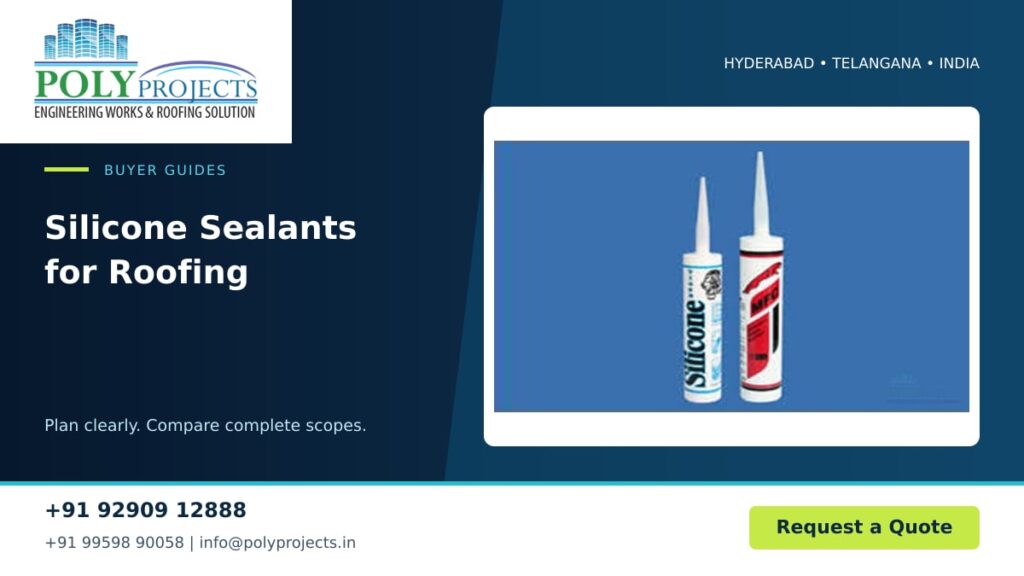
Sealant colour is easy to compare, but it is not the first roofing decision. The joint design, contact surfaces, exposure and intended function determine what evidence is needed for selection. Before ordering silicone sealants for a Hyderabad roofing requirement, identify the actual materials being joined and ask for the exact product guidance. A familiar cartridge or a general weatherproof description does not establish suitability. The purchase should connect a named sealant with a defined application and an approved preparation and installation method.
Describe the joint and its purpose
Record where the sealant will be used and whether the proposal concerns a sheet lap, wall junction, flashing interface or another detail. Include drawings and photographs showing the surrounding assembly. A sealing task is not automatically a structural bonding task, and a product should not be assigned a function beyond its documented intended use. Ask who is responsible for joint design and whether another detail needs correction before sealant is considered. Applying a new bead is not a substitute for understanding the assembly.
List every contact surface accurately
Identify the metal, coating, plastic, gasket, tape, backing material and other products that may contact the sealant. Use exact names or product documents where possible. For example, a painted flashing and a plastic roofing sheet create a more specific selection question than metal to plastic. Include cleaners or primers proposed for the work. EPDM rubber gaskets should also be identified when present. The supplier needs the real combination, including coatings and accessories, rather than only the broad materials visible in a photograph.
Request compatibility and adhesion guidance
Ask the sealant manufacturer or authorised technical source what evidence is required for the actual substrates and accessories. Compatibility and adhesion are related but distinct checks: a combination must be suitable and the sealant must bond as required for the application. Product guidance may call for testing or particular preparation. Do not generalise that all neutral-cure silicones are safe for all plastics. Prestressed polycarbonate can be susceptible to crazing in some applications; polycarbonate roofing sheets require careful review of exact manufacturer requirements and the proposed assembly.
Review the application conditions
Obtain the current technical data sheet and installation instructions for the offered product. Ask about preparation, primer requirements if any, joint arrangement, backing material, curing conditions and restrictions relevant to the site. Do not invent generic bead dimensions or curing times. A roof detail exposed to movement or weather needs a product-specific approach and a responsible person to approve it. If the installer proposes an equivalent cartridge, ask for a fresh review rather than assuming the previous instructions still apply.
Separate a material order from a repair proposal
Clarify whether the enquiry is for supply, a new installation detail or investigation of an existing leak. A sealant supplier cannot establish the cause of water entry from a product name alone. If repair work is being considered, document the issue and confirm repair-service availability and assessment scope before assuming it is offered. Avoid describing any cartridge as a permanent solution to all roof leaks. The required outcome is an agreed detail with appropriate evidence, preparation and inspection, not an unsupported performance promise.
Keep a record that supports later maintenance
Record the approved sealant designation, colour, relevant batch or expiry information, associated primer if specified and the drawing or detail where it is used. Obtain storage and care instructions and retain any compatibility assessment. Agree who checks delivered cartridges against the approved product and who approves substitutions. Poly Projects can discuss material selection and supply, with fabrication or installation support subject to a defined scope. Confirm that scope and the actual Hyderabad or Telangana location before ordering material for a scheduled site visit.
Buyer comparison checklist
| Decision | Evidence to request | Do not assume |
|---|---|---|
| Contact materials | Exact compatibility review | All neutral-cure products suit all plastics |
| Joint function | Approved detail and intended use | Every sealant can provide structural bonding |
| Application | Current product instructions | One bead size or curing time fits all work |
Frequently asked questions
Is neutral-cure silicone always safe for polycarbonate?
No. Check the exact sealant, polycarbonate product, stress conditions and application guidance. Some applications involving prestressed polycarbonate can craze, so a general neutral-cure label is insufficient.
Can I match the old sealant by colour?
Colour does not identify chemistry, suitability or adhesion. Identify the substrates and required function, then request evidence for a named replacement product and preparation method.
Will adding sealant stop a roof leak?
A leak needs investigation of its cause and relevant roof details. Sealant may be part of an approved solution, but should not be assumed to correct every water-entry problem.
Discuss your requirement in Hyderabad
Poly Projects can support supply, material selection, fabrication and installation requirements, subject to the project scope. For Hyderabad and Telangana enquiries, confirm location coverage and the proposed work before ordering. Request a project quote, call +91 92909 12888 first, or +91 99598 90058. Email info@polyprojects.in with drawings, photographs and the required delivery or installation scope. You can also send your requirement on WhatsApp.
For related project enquiries, explore Silicone Sealants Supplier in Hyderabad with Poly Projects.
Discuss your project with Poly Projects, Roofing Contractors in Hyderabad, for roofing material selection and project requirements.